The Ancient Art of Hast Rekha Shastra
Palmistry — known in India as Hast Rekha Shastra (the science of hand lines) or Samudrik Shastra (the ocean of knowledge from bodily signs) — is one of the oldest divinatory arts in human civilisation. References to palm reading appear in ancient Indian texts dating back over 5,000 years, and the practice was integral to the Vedic knowledge systems that also gave birth to Jyotish Shastra (astrology) and Ayurveda.
Unlike popular misconceptions that reduce palmistry to carnival fortune-telling, traditional Hast Rekha Shastra is a systematic study of the hand's structure — its lines, mounts, fingers, skin texture, flexibility, and proportions. Each element carries specific meaning, and their combined interpretation creates a detailed portrait of an individual's character, health predispositions, mental aptitudes, and life patterns.
What makes palmistry uniquely valuable as a complementary tool to Kundali analysis is its immediacy and accessibility. While a birth chart requires precise birth data (time, date, and place), your palms are always available for reading. Moreover, the lines on your palms are not static — they evolve over time, reflecting changes in your health, mindset, and life circumstances. This dynamic quality makes palmistry both a diagnostic and a monitoring tool.
Acharya R.K. Mishra integrates palmistry into his holistic consultation approach, using it alongside Kundali analysis and numerology to provide multi-dimensional guidance that no single system can offer alone.
The Four Major Lines of the Palm
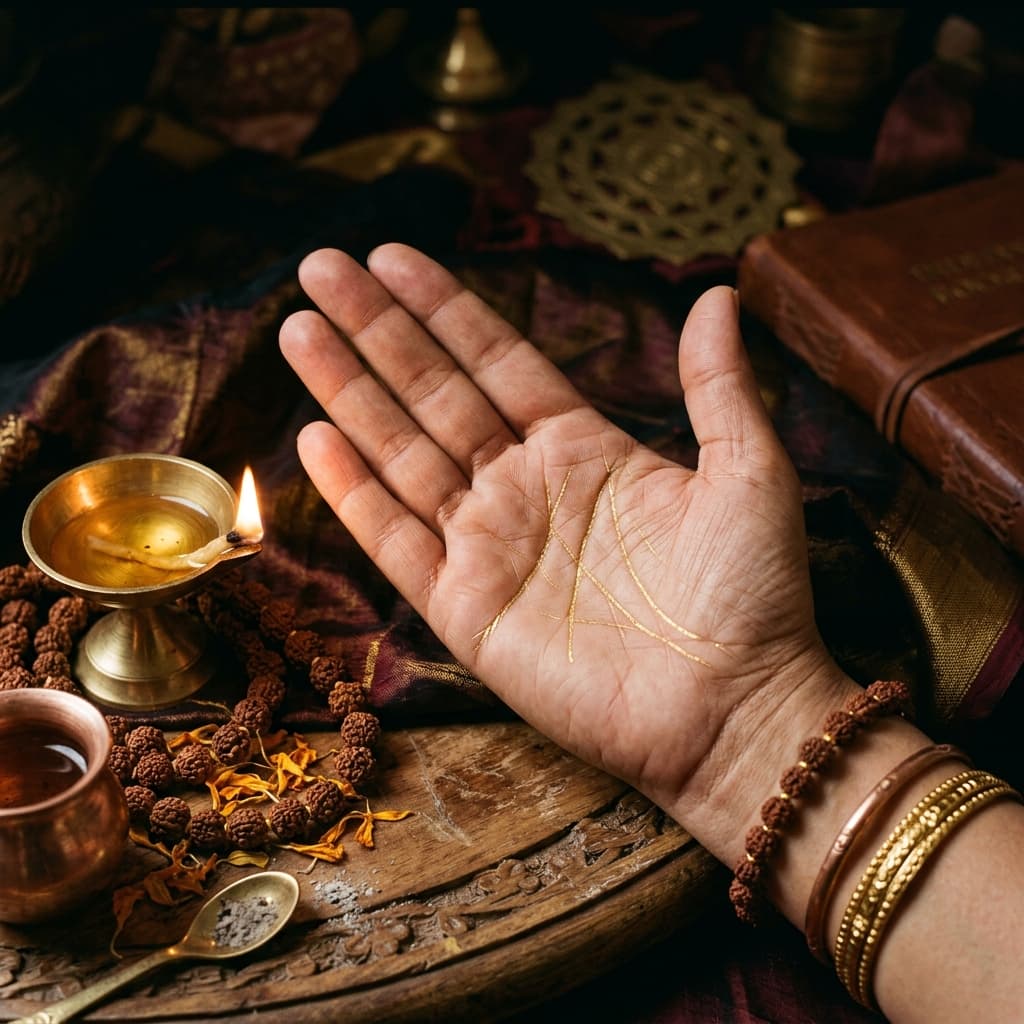
Every palm reading begins with an examination of the four primary lines — the foundational indicators that reveal the core themes of your life:
1. The Heart Line (Hridaya Rekha)
Running horizontally across the upper palm from the edge below the little finger toward the index or middle finger, the heart line governs your emotional life — romantic relationships, emotional resilience, capacity for love, and cardiac health.
- Long, deep, and unbroken: Indicates a warm, generous emotional nature with strong, lasting relationships.
- Short or faint: Suggests a more reserved emotional expression — not a lack of feeling, but a tendency toward logic over sentiment in relationships.
- Curved upward toward fingers: Indicates an expressive, outwardly affectionate personality.
- Branches rising upward: Positive emotional experiences and fulfilling relationships at those life stages.
- Islands or chains: Periods of emotional turbulence, stress, or cardiac sensitivity that warrant attention.
2. The Head Line (Mastishk Rekha)
Starting at or near the edge of the palm between thumb and index finger, the head line crosses the middle of the palm, representing your intellectual style, decision-making approach, and mental resilience.
- Long and straight: Analytical, logical thinking — common in engineers, scientists, and strategists.
- Curved downward toward the wrist: Creative, imaginative, and intuitive thinking — common in artists, writers, and healers.
- Deep and clear: Strong concentration, memory, and mental stamina.
- Forked end (Writer's Fork): The ability to see both logical and creative perspectives — a hallmark of versatile thinkers and communicators.
3. The Life Line (Jeevan Rekha)
Curving from the edge of the palm between thumb and index finger down toward the wrist, the life line is perhaps the most misunderstood line in palmistry.
Critical clarification: The life line does not indicate how long you will live. Its length has no correlation with lifespan. Instead, it reflects your vitality, physical energy, quality of life, and major life changes.
- Deep, well-defined arc: Robust physical vitality and an active, engaged approach to life.
- Wide arc (away from thumb): An adventurous, expansive life with diverse experiences.
- Close to thumb: A more cautious, home-centred lifestyle with deeper focus on fewer pursuits.
- Breaks or islands: Significant life transitions, health events, or periods requiring recuperation at those approximate life stages.
4. The Fate Line (Bhagya Rekha)
Running vertically from the base of the palm upward toward the middle finger, the fate line — also called the Saturn line or destiny line — indicates career development, life direction, and the degree to which external circumstances shape your path.
- Deep and unbroken: A clear, self-directed career path with strong professional identity from an early age.
- Beginning from the life line: Career success achieved through personal effort and family support.
- Beginning from the centre of the palm: A self-made individual who builds their career independently.
- Absent or faint: Does not indicate failure — rather, a person whose path is shaped more by choice and flexibility than by a single, predetermined career track.
Secondary Lines and Special Markings
Beyond the four major lines, experienced palmists examine several secondary lines and special markings that add depth and specificity to the reading:
Sun Line (Surya Rekha)
A vertical line running toward the ring finger, the Sun line indicates fame, success, creative fulfilment, and public recognition. A clear Sun line is found in the hands of successful artists, leaders, and public figures. Its absence does not mean failure — simply that recognition may come through quieter channels.
Mercury Line (Health Line)
Running diagonally from the base of the palm toward the little finger, this line relates to health — particularly digestive and nervous system functioning. Paradoxically, the absence of this line is considered favourable, indicating robust health. When present, its quality reveals periods of health sensitivity.
Marriage Lines
Small horizontal lines on the edge of the palm below the little finger indicate significant romantic relationships and partnerships. Their depth, length, and markings provide insights into the timing and quality of these relationships — complementing the analysis from Kundali matching.
Special Markings
- Stars: Sudden, significant events — positive on mounts, potentially challenging on lines.
- Crosses: Turning points or obstacles requiring decision-making. A cross on Jupiter mount (below index finger) is traditionally considered very auspicious — indicating a blessed marriage or significant spiritual event.
- Triangles: Talent and achievement in the area governed by the mount or line where they appear.
- Squares: Protection — they indicate that you will be shielded from the negative effects of any line breaks or challenges they enclose.
- Grilles: Scattered energy or frustration in the area of the mount where they appear, often indicating a need to focus and channel efforts more deliberately.
The Seven Mounts: Elevated Areas of the Palm
The mounts are the fleshy, elevated areas of the palm, each named after a celestial body and governing specific qualities and life domains. Their development (raised, flat, or overdeveloped) reveals your natural strengths and tendencies:
- Mount of Jupiter (below index finger): Leadership, ambition, self-confidence, and wisdom. A well-developed Jupiter mount indicates natural authority and a strong moral compass — qualities often seen in successful managers, educators, and spiritual leaders.
- Mount of Saturn (below middle finger): Discipline, responsibility, introspection, and karmic awareness. A balanced Saturn mount produces individuals who are reliable, methodical, and deeply thoughtful — valued in fields requiring patience and precision.
- Mount of Sun/Apollo (below ring finger): Creativity, charisma, artistic talent, and public success. A prominent Sun mount is the hallmark of performers, artists, designers, and anyone whose work involves beauty and self-expression.
- Mount of Mercury (below little finger): Communication, business acumen, scientific aptitude, and healing abilities. A strong Mercury mount is consistently found in the palms of successful entrepreneurs, doctors, writers, and orators.
- Mount of Venus (base of thumb): Love, vitality, sensuality, and warmth. This is the largest mount and reflects your capacity for affection, physical energy, and enjoyment of life's pleasures.
- Mount of Moon/Luna (opposite side from Venus, lower palm): Imagination, intuition, creativity, and connection to the subconscious. A well-developed Moon mount indicates a rich inner life, vivid dreams, and natural psychic sensitivity.
- Mount of Mars (two locations — inner and outer): Courage, resilience, and fighting spirit. Inner Mars (between Jupiter and Venus) governs inner courage and moral strength. Outer Mars (between Mercury and Moon) governs physical endurance and the ability to withstand external pressures.
The relative development of these mounts creates a unique "topographical map" of your personality — revealing at a glance where your natural energies are concentrated and where they may need cultivation.
Reading Your Dominant vs Non-Dominant Hand
A question that often arises in palmistry readings is: which hand should be read? The answer is both — but for different purposes:
Non-Dominant Hand (Usually Left)
Your non-dominant hand represents your innate potential — the qualities, talents, and predispositions you were born with. Think of it as your "nature" hand. The lines here show what you came into this world equipped with — your raw material.
Dominant Hand (Usually Right)
Your dominant hand represents your active life — what you are actually doing with your innate potential. Think of it as your "nurture" hand. The lines here evolve more rapidly, reflecting your choices, efforts, and life experiences.
Comparing Both Hands
The most valuable insights come from comparing both palms. When the dominant hand shows stronger, clearer lines than the non-dominant hand, it indicates that you are actively developing and exceeding your innate potential — a very positive sign. When the non-dominant hand is stronger, it may suggest untapped potential or a period where circumstances have not yet allowed your natural abilities to fully express themselves.
An experienced palmist like Acharya R.K. Mishra reads both hands in every session, tracking not just current patterns but the trajectory of change — which provides actionable insights about where your energy is heading and what adjustments might serve you best.
What Palmistry Reveals About Health and Wealth
Hast Rekha Shastra offers specific indicators for two of the most universally sought topics — health and financial prosperity:
Health Indicators
- Nails: Shape, colour, and markings on fingernails reveal circulatory, respiratory, and nutritional health. Pale nails may indicate anaemia; ridged nails suggest nutritional deficiencies; bluish tints may point to circulatory issues.
- Mercury Line: When present, its clarity and position indicate digestive and nervous system health. A wavy or fragmented Mercury line suggests periods of stress-related health challenges.
- Life Line quality: Islands, chains, or colour changes at specific points correspond to approximate ages where health vigilance is recommended.
- Skin texture and flexibility: Elastic, resilient skin with good colour indicates strong vitality. Dry, rigid hands may suggest stress, dehydration, or constitutional imbalances that Ayurvedic attention could address.
Wealth Indicators
- Fate Line depth and clarity: A strong fate line indicates a clear career trajectory with consistent income growth.
- Sun Line presence: Indicates wealth through recognition, fame, or creative success — particularly when it runs parallel to the fate line.
- Triangle of Wealth: Formed by the intersection of the head line, fate line, and Mercury line — this rare formation indicates significant wealth accumulation and financial intelligence.
- Venus mount development: A full, well-padded Venus mount indicates someone who attracts abundance and enjoys material comforts.
These indicators are most powerful when cross-referenced with a Janma Kundali analysis — allowing the astrologer to confirm and deepen the insights from both systems simultaneously.
What to Expect from a Professional Palmistry Reading
A professional palmistry consultation with a qualified practitioner like Acharya R.K. Mishra is a structured, insightful experience — quite different from casual palm readings:
- Both Hands Examination: Both palms are examined — non-dominant for innate potential, dominant for active life patterns.
- Line Analysis: All major and relevant minor lines are mapped and interpreted — their depth, length, branches, breaks, and special markings.
- Mount Assessment: The development and relative prominence of all seven mounts are evaluated to build a personality and aptitude profile.
- Finger and Nail Analysis: Finger proportions, joint flexibility, and nail characteristics add layers of detail about temperament, health, and intellectual style.
- Cross-Reference with Kundali: In Acharya Mishra's integrated approach, palmistry findings are cross-referenced with your birth chart for maximum accuracy. Where both systems agree, the indication is considered very strong. Where they differ, deeper investigation reveals the nuance.
- Practical Guidance: Rather than just describing what the lines show, a professional reading provides actionable guidance — which health areas to monitor, which career strengths to leverage, and which relationship patterns to be mindful of.
The session typically takes 30 to 45 minutes and can be conducted in person or via video call (using clear, well-lit photographs of both palms). Acharya R.K. Mishra's palmistry readings are available as standalone consultations or as part of a comprehensive session that also includes Kundali analysis and numerology — providing the most complete picture of your life's patterns and potential.